

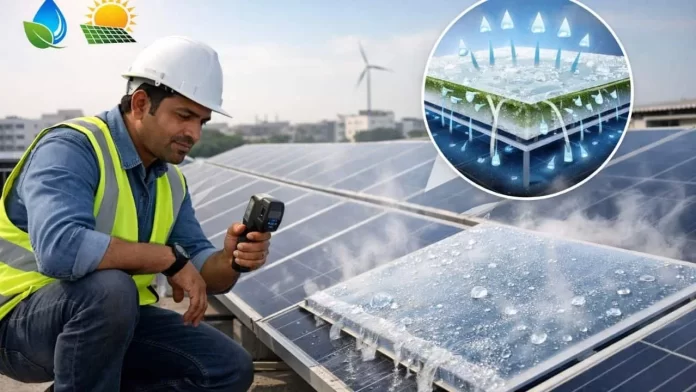

The biggest challenge in generating electricity from solar panels is the problem of heat, or “hot spots,” because the panels become extremely hot in strong sunlight and high temperatures. When the panel temperature rises, its efficiency gradually decreases, directly impacting electricity production. This heat can also shorten the lifespan of the panels, increasing maintenance and replacement costs. This problem is particularly prevalent in rooftop solar systems and building-integrated solar systems. To address this challenge, scientists are continuously working on new technologies, and Hydrogel Technology is now considered a major breakthrough.
How does the new Hydrogel Technology work its magic?
Scientists at Hong Kong Polytechnic University have developed a special type of hydrogel coating that can effectively cool hot spots on solar panels. This hydrogel is primarily composed of a water-absorbing gel called polyacrylamide and hydroxyethyl cellulose, which enhances its strength and durability. It incorporates special cotton threads that create a leaf-like structure, directing water to the hottest areas of the panel. This ensures uniform cooling across the entire panel. The outer layer of this hydrogel is made of a thin, porous film similar to Teflon, which prevents dust accumulation and controls water evaporation. According to the research, this new technology can lower the temperature of solar panels by up to 16.2 degrees Celsius, while traditional hydrogels only provide cooling of about 10 degrees. This is why this new coating is considered more effective.
More power, greater sustainability, and future prospects.
The biggest advantage of this advanced hydrogel coating is that by increasing cooling, it can boost the power generation capacity of solar panels by approximately 13%. Research has also shown that this technology can reduce nearly half of the power losses caused by hot spots in rooftop and BIPV systems. Studies in hot and humid regions like Hong Kong and Singapore have shown that an increase of 6 to 7 percent in annual power generation is possible, and the investment can be recovered within 3 to 4.5 years.
Furthermore, this new hydrogel exhibits fewer problems with shrinkage and cracking, resulting in a longer lifespan compared to traditional hydrogels. Scientists are now working on further improving this technology, reducing production costs, and conducting large-scale testing in different climatic conditions. If this technology becomes widely available in the market in the future, it could bring about a significant transformation in the solar energy sector, providing consumers with more electricity, reduced losses, and better returns on investment.